New Military Exchange Deepens US-Iran Tensions
A fresh confrontation between the United States and Iran has intensified tensions across the Gulf region, raising concerns about regional stability and the future of ongoing diplomatic efforts. The latest clash began after Iranian missiles and drones targeted locations in Kuwait and Bahrain, prompting a swift military response from the United States.
Moreover, the incident has placed renewed pressure on fragile ceasefire arrangements and increased fears of a broader conflict involving multiple countries in the Middle East.
Iran Launches Missiles and Drones Toward Gulf Targets
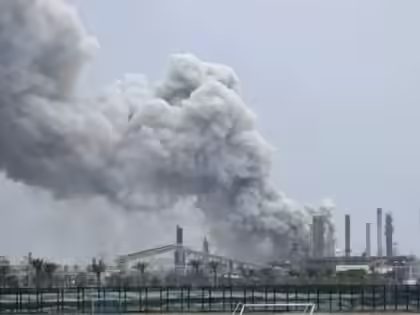
According to US Central Command, Iran launched several missiles and drones toward US-linked military facilities in Kuwait and Bahrain. However, most of the projectiles were intercepted by air defense systems or failed to reach their intended targets.
Meanwhile, Iranian officials described the attacks as retaliation for recent American military actions in the Gulf. The Islamic Revolutionary Guard Corps (IRGC) claimed that its operations were a response to what it viewed as provocative US actions near the Strait of Hormuz.
As a result, regional security forces were placed on high alert amid fears of further escalation.
US Responds With Strikes on Iranian Military Infrastructure
In response to the missile and drone attacks, US forces carried out strikes on Iranian military facilities located on Qeshm Island. American officials stated that the operation targeted military infrastructure linked to missile launches and drone operations.
Furthermore, US forces reportedly intercepted additional drones that posed a threat to military assets and commercial shipping routes. Washington described the operation as a defensive measure aimed at protecting personnel and maintaining regional security.
Consequently, the exchange has become one of the most serious military confrontations between the two countries in recent weeks.
Strait of Hormuz Remains a Major Flashpoint
The latest clash has once again drawn attention to the Strait of Hormuz, one of the world’s most important energy transit routes. A significant share of global oil exports passes through the narrow waterway each day.
Moreover, disruptions in the area have already affected shipping operations and increased uncertainty in energy markets. Analysts warn that prolonged instability could lead to higher oil prices and supply chain disruptions worldwide.
Therefore, developments in the Strait continue to carry major economic and geopolitical implications.
Peace Talks Face Fresh Challenges
The military exchange comes at a time when diplomatic efforts between Washington and Tehran are already facing significant obstacles. Reports indicate that negotiations aimed at reducing tensions have stalled amid disagreements over sanctions, regional security, and nuclear-related issues.
However, both sides have left the door open for future dialogue. US officials maintain that diplomacy remains the preferred option, while Iran has continued to demand changes in American policies before making further commitments.
Nevertheless, repeated military incidents are making progress increasingly difficult.
Regional and Global Concerns Intensify
Several Gulf countries have expressed concern over the renewed hostilities. Governments across the region are strengthening security measures and monitoring the situation closely to prevent further escalation.
In addition, international observers fear that continued clashes could affect global trade, energy security, and regional stability. Markets have already reacted to the latest developments, with oil prices rising as investors assess the risks associated with the conflict.
As a result, world powers are urging restraint and calling for renewed diplomatic engagement.
Conclusion
The latest US-Iran military exchange has significantly heightened tensions in the Gulf and renewed concerns about the possibility of a wider regional conflict. While US forces responded to Iranian missile and drone attacks with strikes on military infrastructure, both sides continue to accuse each other of escalating the crisis.
Moreover, with peace talks facing uncertainty and the Strait of Hormuz remaining a strategic flashpoint, the coming days will be crucial in determining whether diplomacy can prevent further escalation.