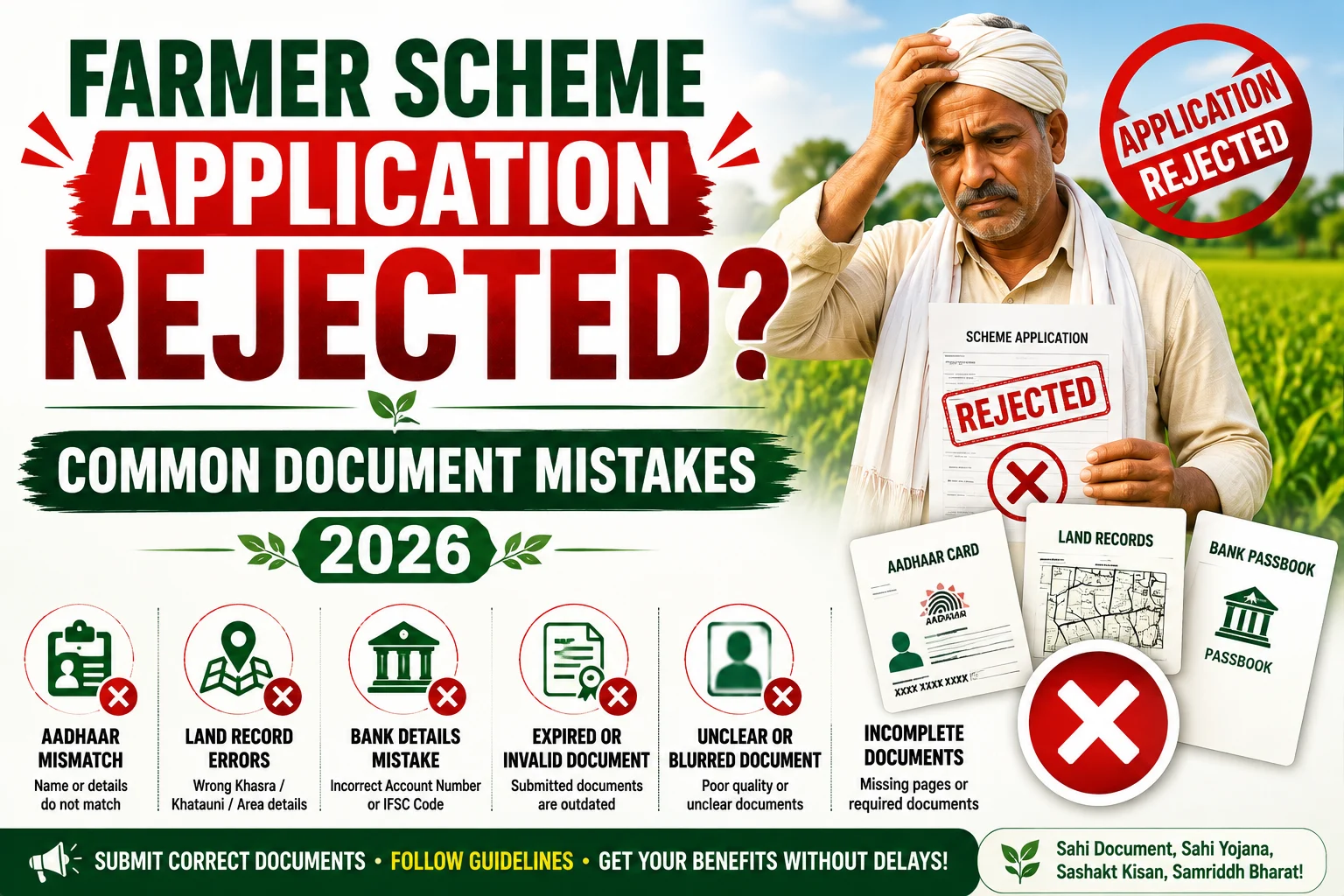
Farmers can apply for many Central and State Government schemes in 2026. These schemes provide support through subsidies, financial assistance, crop insurance, pensions, agricultural equipment, DBT payments and other farming services. However, submitting an application does not always guarantee approval.
In many cases, farmers face rejection or delays because the information in their application does not match government records. A small spelling mistake, an incorrect bank account number or an outdated land record can create problems during verification.
Digital verification has also become more important. Farmer records are increasingly connected with Aadhaar, land records, bank details, Farmer ID and other government databases. Therefore, farmers should keep all important documents accurate and updated.
If your farmer scheme application was rejected, do not immediately submit another application. First, check the reason for rejection. Then identify the incorrect document or information and correct it through the appropriate department.
This guide explains the common document mistakes that can cause farmer scheme applications to be rejected in 2026. It also explains how to correct errors, which documents farmers should keep ready and what steps to follow after rejection.
Why Do Farmer Scheme Applications Get Rejected?
Government departments verify applications before approving benefits. The verification process can compare information from several records.
For example, officials may check:
- Aadhaar details
- Farmer ID
- Land ownership records
- Bank account information
- Mobile number
- eKYC status
- Village and district details
- Crop information
- Income or category certificates
- Previous beneficiary records
A mismatch between two records can stop the application from moving forward.
For instance, a farmer may enter the correct bank account number but have a different name in the bank record. Similarly, the farmer’s Aadhaar may show one spelling while the land record shows another.
The Government’s AgriStack initiative is also developing a Farmer Registry that connects farmer identity with farmland records. As digital agriculture services expand, accurate farmer and land information is becoming increasingly important.
Common Document Mistakes That Cause Rejection
| Document or Detail | Common Mistake | Possible Problem |
|---|---|---|
| Aadhaar | Incorrect number or name | Authentication failure |
| Name | Different spelling | Identity mismatch |
| Land Record | Old ownership details | Land verification problem |
| Khasra/Survey Number | Wrong number | Wrong land parcel |
| Land Area | Incorrect measurement | Eligibility mismatch |
| Bank Account | Wrong account number | Payment failure |
| IFSC | Outdated code | DBT problem |
| Mobile Number | Incorrect number | OTP failure |
| Farmer ID | Missing or incorrect details | Digital verification issue |
| eKYC | Not completed | Benefit may remain pending |
| Certificates | Expired or invalid | Application rejection |
| Documents | Blurred or incomplete | Verification failure |
| Application | Duplicate submission | Record conflict |
1. Name Mismatch in Aadhaar and Farmer Records
A name mismatch is one of the most common problems in farmer applications.
For example, Aadhaar may show Ramesh Kumar, while the land record may show Ramesh Kumar Singh. In another case, one document may spell the name as Sushila and another as Sushila Devi.
Such differences can create problems during automated verification.
First, compare the name across all important documents. Check Aadhaar, land records, bank passbook and scheme registration details.
If Aadhaar contains the mistake, follow the applicable Aadhaar correction process. On the other hand, if the land record contains the error, contact the concerned revenue authority.
For PM-KISAN, the official portal provides a Name Correction as per Aadhaar facility. Therefore, farmers should use the correction option instead of creating another registration.
2. Incorrect Aadhaar Number
Entering an incorrect Aadhaar number can cause authentication to fail.
Farmers should carefully check all 12 digits before submitting an application. A single incorrect digit can prevent the system from identifying the correct beneficiary.
Before submitting the form, verify:
- Aadhaar number
- Name
- Date of birth
- Gender
- Mobile number
If Aadhaar authentication fails, check the entered information first. Do not create a second application without understanding the problem.
3. Aadhaar Details Do Not Match
A farmer may enter the correct Aadhaar number but still face a verification issue.
This can happen when the name, date of birth or other demographic details differ between the application and Aadhaar.
For example:
Aadhaar: Mohan Lal
Application: Mohanlal
Although both names may belong to the same person, the digital system may not always treat them as an exact match.
Farmers should therefore keep their identity records consistent wherever possible.
4. eKYC Is Not Completed
Many government schemes now use eKYC to verify beneficiaries.
PM-KISAN, for example, requires registered farmers to complete eKYC according to the current scheme process. A farmer may successfully submit an application but still experience payment or verification issues if eKYC remains incomplete.
Farmers should check whether their eKYC status shows:
- Completed
- Pending
- Failed
- Not available
If eKYC has failed, the farmer should follow the official correction or authentication process.
5. Incorrect Bank Account Number
Bank details are especially important for schemes that provide financial assistance through DBT.
A farmer may enter an incorrect account number by mistake. Even one missing or extra digit can cause payment failure.
Common bank-related mistakes include:
- Wrong account number
- Closed account
- Inactive account
- Account belonging to another person
- Incorrect account-holder name
- Old bank details
Farmers should compare the application with their latest bank passbook or official bank statement.
6. Incorrect IFSC Code
An incorrect IFSC code can also create payment problems.
Farmers may unknowingly use an old IFSC when their bank branch has changed or merged with another branch.
Before submitting an application, check the current IFSC through the bank or latest account documents.
If the bank account has recently changed, update the relevant government scheme record as soon as possible.
7. Aadhaar and Bank Details Do Not Match
A farmer can have correct Aadhaar information and correct bank information but still face a problem if the required linkage is incomplete.
For schemes that use Aadhaar-linked payment systems, farmers should confirm that their banking information meets the applicable requirements.
Visit the bank if you are unsure about:
- Aadhaar seeding
- Account status
- DBT eligibility
- Name matching
- Bank-account linkage
Once the bank resolves the issue, update the scheme record if necessary.
8. Outdated Land Records
Land records play an important role in many agriculture schemes.
A farmer may have purchased land several months ago, but the official revenue record may still show the previous owner. Similarly, inherited land may remain in the name of a deceased family member.
This situation can create a mismatch during scheme verification.
Farmers should complete the applicable mutation process after purchase, inheritance or other ownership changes.
An updated land record can make it easier to establish the farmer’s relationship with the agricultural land.
9. Wrong Khasra, Survey or Gata Number
Agricultural land records contain important identification numbers.
Depending on the state, these may include:
- Khasra number
- Survey number
- Gata number
- Plot number
- Khata number
- Sub-survey number
Entering the wrong number can connect the application with another land parcel.
Always compare the number in the application with the latest official land record. Do not enter the number from memory.
10. Incorrect Land Area
Land-area mistakes can also cause verification problems.
For example, a farmer may enter 2 hectares in the application while the official record shows 1.5 hectares.
Such differences can affect eligibility or benefit calculations.
Farmers should use the area recorded in the relevant official land document. They should also use the measurement unit requested by the application.
Do not convert acres, hectares or local land measurements without checking the correct conversion.
11. Ownership Details Are Not Updated
Agricultural land can have single or joint ownership.
Problems may arise when:
- A family member has died.
- Land has been divided.
- A sale has taken place.
- A family settlement has been completed.
- Ownership shares have changed.
- Mutation has not been completed.
Farmer Registry systems can contain information about land parcels, owners, ownership extent and joint ownership. Therefore, outdated ownership records can create digital verification problems.
Farmers should update revenue records whenever a legally recognized ownership change takes place.
12. Inherited Land Is Still in the Previous Owner’s Name
Inheritance-related land records often cause difficulties.
Suppose a farmer inherits land from a parent. The family may have the death certificate and other legal documents, but the revenue record still shows the parent’s name.
In that situation, the farmer may not be able to establish ownership through the current digital land record.
Depending on the case, the family may need:
- Death certificate
- Legal heir certificate
- Will, where applicable
- Succession documents
- Mutation documents
- Previous land records
- Identity documents
The exact requirements depend on the state and the nature of the inheritance.
13. Farmer ID Is Missing or Incorrect
Farmer ID is becoming an important part of the digital agriculture ecosystem.
The Farmer Registry is designed to provide farmers with a unique Farmer ID and connect farmer information with agricultural land records.
However, farmers should not assume that every government scheme uses the same Farmer ID process.
State governments may follow different registration and correction procedures.
If your Farmer ID contains incorrect information, first check the state Farmer Registry system. You may also need to approach an authorized service centre or agriculture department.
14. Duplicate Farmer Applications
Submitting multiple applications can create unnecessary complications.
Farmers sometimes submit a second application because the first application remains pending. Others create a new application after changing their mobile number or correcting a document.
Before submitting another application, check the status of the existing registration.
Follow this order:
- Check application status.
- Read the rejection or pending reason.
- Correct the information.
- Use the official correction facility.
- Resubmit only if the scheme allows it.
This approach reduces the risk of duplicate records.
15. Incorrect Mobile Number
An incorrect mobile number can cause problems with OTP verification and scheme communication.
Farmers should provide an active number that they regularly use.
A mobile number may be required for:
- OTP verification
- eKYC
- Registration updates
- Application notifications
- Payment-related information
If the registered mobile number has changed, use the official update facility wherever available.
16. Blurred or Incomplete Documents
A document can be genuine and still fail verification if the uploaded copy is unclear.
Common problems include:
- Blurred photographs
- Cropped documents
- Missing pages
- Glare
- Very dark images
- Unreadable text
- Wrong file format
- File larger than the permitted size
Before uploading a document, make sure all important information is clearly visible.
For physical applications, carry the original documents along with photocopies whenever the department requires them.
17. Expired Certificates
Some agriculture schemes require additional certificates.
These may include:
- Income certificate
- Caste certificate
- Residence certificate
- Cultivation certificate
- Disability certificate
If the scheme requires a certificate with a specific validity period, an old certificate may not be accepted.
Farmers should check the latest scheme notification before using a previously issued certificate.
18. Incorrect Category Details
Some schemes provide benefits based on specific categories.
Applicants should select their actual category and submit a valid certificate if the scheme requires one.
For example, if an application asks for a category certificate, the applicant should upload a certificate issued by the competent authority.
Incorrect category information can lead to rejection during verification.
19. Wrong Address or Village Details
A farmer may accidentally select the wrong:
- State
- District
- Block
- Tehsil
- Village
This can create a mismatch with land records.
PM-KISAN also provides an address-correction process for certain cases involving incorrect State or District information. The official process may require proof of cultivable land in the farmer’s name.
Farmers should therefore check location details carefully before final submission.
20. Applying Without Checking Eligibility
Not every farmer qualifies for every scheme.
Eligibility can depend on:
- Age
- Landholding
- State
- Income
- Crop
- Farmer category
- Ownership
- Cultivation status
- Existing government benefits
- Other scheme-specific conditions
A complete document set cannot compensate for failure to meet the basic eligibility requirements.
Always read the latest eligibility conditions before applying.
What Should You Do If Your Farmer Scheme Application Is Rejected?
A rejection does not always mean that you cannot receive the benefit.
Follow these steps to identify and resolve the problem.
Step 1: Check the Application Status
Open the official portal and check the current status.
Look for terms such as:
- Rejected
- Pending
- Correction required
- Verification pending
- Ineligible
- Payment failed
Step 2: Read the Rejection Reason
Find out exactly which document or information caused the problem.
Avoid making assumptions.
Step 3: Compare Your Documents
Compare the application information with:
- Aadhaar
- Bank passbook
- Land records
- Farmer ID
- Certificates
This comparison can help identify the mismatch.
Step 4: Correct the Original Document
If the source document is incorrect, correct it first.
For example, correct a land record through the relevant revenue authority instead of trying to change only the scheme application.
Step 5: Update the Scheme Record
Once the source document is corrected, update the relevant scheme record.
Step 6: Submit a Correction or Grievance
Use the official correction facility if one is available.
For PM-KISAN, the official portal provides grievance services for various beneficiary-related issues.
Step 7: Track the Request
Keep the acknowledgement number or application reference number.
Check the status regularly until the correction is completed.
Documents Farmers Should Keep Ready for Corrections
A general document folder should contain:
- Aadhaar Card
- Bank passbook
- Updated land record
- Khasra/Khatauni/Jamabandi
- Sale deed
- Mutation document
- Farmer ID
- PM-KISAN registration details
- Mobile number
- Address proof
- Income certificate, where required
- Caste certificate, where required
- Legal heir documents, where applicable
- Other scheme-specific documents
Farmers do not need every document for every correction. The required documents depend on the problem and the particular scheme.
How to Prevent Rejection Before Applying
Prevention is easier than correction.
Before submitting an application, farmers should follow a simple checklist.
Check Your Name
Make sure your name matches the relevant identity and bank records.
Check Aadhaar
Verify the Aadhaar number and demographic information.
Check Land Records
Use the latest available land record.
Check Ownership
Make sure mutation is complete after inheritance, purchase or partition.
Check Bank Details
Verify the account number and current IFSC.
Check Mobile Number
Use an active mobile number.
Complete eKYC
Complete eKYC whenever the scheme requires it.
Check Farmer ID
Verify Farmer Registry information where applicable.
Upload Clear Documents
Make sure every uploaded document is readable.
Check Eligibility
Read the scheme conditions before applying.
Avoid Duplicate Registration
Always check the existing application status first.
PM-KISAN Application Rejected: Important Checks
PM-KISAN is one of the most widely used farmer-support schemes, so documentation errors can affect a large number of applicants.
If a PM-KISAN application or beneficiary record shows a problem, check:
- Aadhaar authentication
- Name as per Aadhaar
- Land information
- State and district
- Bank account
- IFSC
- eKYC
- Beneficiary status
- Eligibility
- Registration information
The official PM-KISAN portal provides farmer-related services for registration, status checking, corrections and grievances.
If the problem relates to land ownership, correcting the underlying revenue record may be necessary before the scheme record can be updated.
Farmer Registry Errors and Scheme Benefits
The growth of digital Farmer Registry systems makes accurate documents increasingly important.
AgriStack’s Farmer Registry is intended to connect the farmer’s identity with farmland information. This approach can help government departments identify beneficiaries and deliver services more efficiently.
For this reason, farmers should not treat their Farmer ID as an isolated number.
The information connected to the Farmer ID should also remain accurate, including:
- Farmer name
- Land parcel
- Ownership
- Land area
- Village
- Other relevant details
If the source land record changes, the farmer should follow the applicable process to update connected digital records.
Difference Between Rejected, Pending and Ineligible
Farmers should understand the difference between these terms.
Rejected
The application has not been approved under the current submission.
Pending
The application is still waiting for verification or another required step.
Ineligible
The applicant does not meet the applicable eligibility conditions.
Correction Required
The department needs the applicant to correct or provide additional information.
The exact terminology can vary from one scheme to another.
When Should You Contact the Department?
Farmers should contact the concerned department or authorized service centre if:
- The portal shows incorrect land details.
- Mutation has been completed but the record remains unchanged.
- Aadhaar authentication repeatedly fails.
- Bank details are correct but payment remains pending.
- Farmer ID information is incorrect.
- A correction request has not been processed.
- The application was rejected despite correct documents.
- The portal displays conflicting information.
- The farmer cannot understand the rejection reason.
For PM-KISAN-related issues, farmers can use the official grievance mechanism available on the scheme portal.
Important Tips for Farmers in 2026
Farmers can avoid many application problems by following these simple practices:
- Keep Aadhaar information updated.
- Maintain the latest land records.
- Complete mutation after ownership changes.
- Check bank details before applying.
- Keep Farmer ID information accurate.
- Complete mandatory eKYC.
- Use clear document scans.
- Check the scheme’s eligibility conditions.
- Never share OTPs with unknown persons.
- Avoid duplicate applications.
- Save acknowledgement numbers.
- Use official government websites and authorized service centres.
Frequently Asked Questions (FAQs)
Why was my farmer scheme application rejected?
A farmer scheme application can be rejected because of name mismatch, Aadhaar errors, incorrect bank details, outdated land records, wrong Khasra or survey number, incomplete eKYC, missing documents, duplicate applications or ineligibility.
Can I apply again after rejection?
It depends on the scheme and rejection reason. First identify the problem and use the available correction or resubmission facility. Creating a duplicate application without checking the existing record can cause further problems.
What if my name is different in Aadhaar and land records?
First identify which record contains the incorrect name. Correct the source document and then update the relevant scheme or Farmer Registry record.
What if my Khasra number is incorrect?
Compare the application with the latest official land record. If the government land record itself contains the error, approach the concerned revenue authority for correction.
Can wrong bank details cause rejection?
Yes. Incorrect bank details can cause verification or payment problems. Farmers should verify the account number and current IFSC before submitting an application.
What if my land mutation is pending?
Complete the applicable mutation process if the scheme depends on current ownership records. A scheme application may not recognize a new owner while the official revenue record still shows the previous owner.
Is Farmer ID required for every farmer scheme?
No. Requirements differ between schemes and states. However, Farmer Registry systems are becoming increasingly important for digital agricultural services.
Can Farmer ID information be corrected?
Farmer Registry systems provide correction mechanisms according to state implementation. Farmers should use the relevant state Farmer Registry portal or authorized channel.
What should I do if my PM-KISAN application is rejected?
Check the official PM-KISAN status, identify the rejection reason, correct the relevant information and use the prescribed correction or grievance facility. The official PM-KISAN portal provides services for beneficiary-related corrections and grievances.
Can PM-KISAN land details be corrected?
Certain land and location-related corrections can be handled through the prescribed PM-KISAN process. However, if the underlying revenue record is incorrect, farmers may first need to correct it through the state land-record authority.
Should I submit a new application after rejection?
Not immediately. Check the rejection reason first. If a correction option exists, use it instead of creating a duplicate application.
What documents should I keep ready after rejection?
Keep Aadhaar, bank passbook, updated land records, Farmer ID, application details and any certificate relevant to the scheme. Additional documents depend on the reason for rejection.
Conclusion
A rejected farmer scheme application does not always mean that the farmer is permanently ineligible. In many cases, the rejection occurs because of a simple document or information mismatch.
The most common problems in 2026 include incorrect names, Aadhaar errors, wrong bank details, outdated land records, incorrect Khasra or survey numbers, incomplete mutation, missing Farmer ID, incomplete eKYC, unclear documents, expired certificates and duplicate applications.
Farmers should first identify the exact reason for rejection. After that, they should correct the original document or record and use the official correction facility provided by the relevant department.
Accurate land information is particularly important as Farmer Registry systems expand. AgriStack’s Farmer Registry connects farmer identity with farmland-plot records, making updated ownership and land information increasingly valuable for digital agriculture services.
Farmers should therefore maintain a complete and updated document set containing Aadhaar, bank details, land records, Farmer ID information and scheme registration details. Completing eKYC and checking application status can also prevent unnecessary delays.
Most importantly, farmers should avoid submitting duplicate applications after rejection. Instead, they should understand the reason, correct the problem and follow the official resubmission or grievance process.